
Read our ultimate guide to starting a family at the Best IVF Fertility Center in Jaipur. Learn about ovulation induction, IUI, ICSI, and modular laboratories.
The choice to seek medical assistance on your journey to start a family is a significant step. In urban areas, rising cases of ovulatory disorders, low sperm motility, and metabolic imbalances can affect natural conception. Seeking an early, accurate diagnostic workup helps couples avoid delay and identify clear, clinical treatment pathways.
At Kulki IVF, the best IVF fertility center in Jaipur, we perform comprehensive diagnostics before cycle planning. We check ovarian reserves, track follicle development, and perform detailed sperm morphology reviews to establish a secure, personalized roadmap for every couple.
Starting a family is a deeply personal and emotional journey. When facing challenges, it is important to remember that you are not alone. Fertility issues affect millions of couples worldwide. The first step toward overcoming these hurdles is understanding the underlying factors. Our clinic provides a supportive, warm environment where you can discuss your concerns openly with experienced specialists. We offer comprehensive diagnostic evaluations for both partners to ensure we identify the root cause of any difficulties, enabling us to design a highly targeted and effective treatment plan. We are dedicated to providing both the emotional support and state-of-the-art clinical expertise necessary to make your dream of parenthood a reality, guiding you through each and every step of the process with warmth, compassion, and professional care.

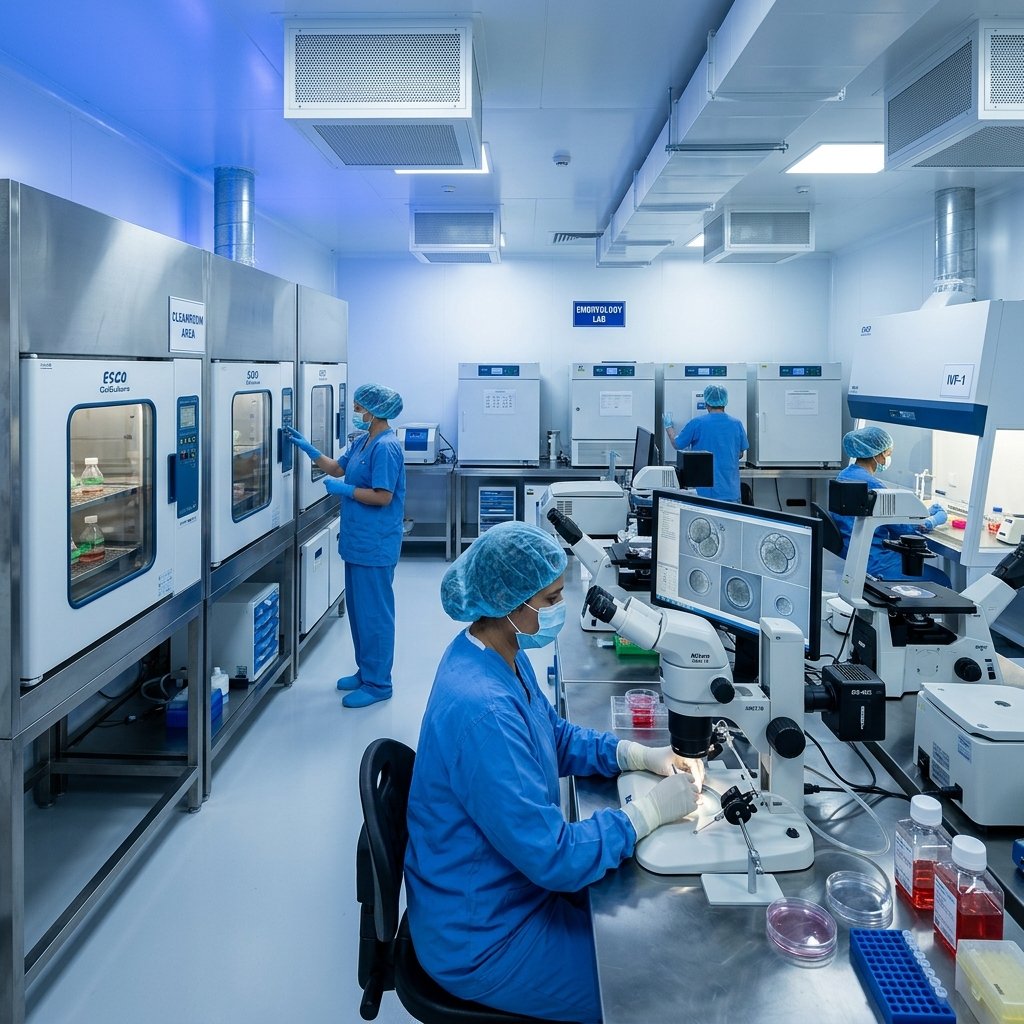
Embryonic development requires a highly stable, secure micro-environment. A slight shift in air temperature, moisture, or chemical particulate levels can disrupt growth. To prevent cellular stress, a top-tier laboratory cleanroom is essential.
Our facility operates an ISO-certified Class 10,000 modular laboratory cleanroom. Equipped with positive pressure, HEPA filtration, and VOC carbon scrubbers, this cleanroom environment maintains optimal physiological metrics continuously, protecting embryos throughout the culturing phase.
| Clinical Protocol | Purpose & Implantation Benefits |
|---|---|
| HEPA Air Filtration | Continuously filters out dust and chemical impurities in embryology. |
| Laser-Assisted Hatching | Preparing the outer embryo shell to support uterine attachment. |
| Blastocyst Transfer | Transferring robust Day-5 embryos for higher clinical success. |
The embryology laboratory is often called the "heart" of an IVF clinic, and for good reason. In this controlled environment, eggs are fertilized and embryos are cultured for up to five days before transfer. Any fluctuation in ambient air quality, temperature, or gas concentrations can cause cellular stress to the embryos, potentially arresting their development. This is why we have built a state-of-the-art Class 10,000 modular laboratory cleanroom. By maintaining strict control over environmental variables, we ensure that your embryos have the best possible chance of growing into healthy, viable blastocysts.
Scientific infrastructure is most effective when directed by experienced experts. Our clinical panel is led by Dr. Asha Sushawat, a veteran reproductive specialist with over 30 years of clinical experience in gynecology and advanced assisted reproductive treatments. Working with her, Dr. Aarti Soni designs customized ovarian stimulation plans, adjusting hormone dosages based on regular monitoring scans to protect patient safety.
Our senior embryologist, Dr. Ssuniti, manages all cleanroom lab procedures, including micromanipulation (ICSI) and cryopreservation vitrification, ensuring that eggs and embryos are handled with extreme care.
Every individual and couple is unique, which means a generic, standardized approach to fertility treatment is rarely effective. We believe in personalized care. During your initial consultations, our specialists will review your medical history, diagnostic results, and lifestyle factors in detail. We then design a customized ovarian stimulation protocol tailored to your specific ovarian reserve and hormonal profile. This hands-on, individualized approach maximizes the number of high-quality eggs retrieved while minimizing the risk of complications such as Ovarian Hyperstimulation Syndrome (OHSS).
We provide a comprehensive range of assisted reproductive options, including IVF, ICSI, IUI, and egg donor cycles. For couples facing male factor challenges, Intracytoplasmic Sperm Injection (ICSI) is performed under high-magnification optics to select and inject a single healthy sperm directly into the egg, bypassing common anatomical barriers to fertilization.
We also provide absolute pricing transparency, delivering clear cost breakdowns during your initial visit. By removing financial stress and unexpected costs, we allow patients to focus fully on their health and family goals.
Advanced sperm selection technologies play a vital role in the success of ICSI procedures. In cases of severe male factor infertility, such as low sperm count (oligospermia) or poor motility (asthenozoospermia), selecting the healthiest sperm is crucial. We utilize advanced laboratory techniques like density gradient washing and microfluidic sorting to isolate sperm with high motility and minimal DNA fragmentation. By selecting the best possible sperm cell for micro-injection, we significantly improve fertilization and blastocyst development rates, offering a clear advantage to couples on their path to parenthood.
Before launching into any clinical cycle, our medical team conducts a series of highly targeted screening evaluations to assess the biological potential of both partners. This ensures that no time or resources are wasted on ineffective protocols. Below is a detailed breakdown of the primary diagnostic screening tools we utilize:
| Diagnostic Assessment | Target Entity / Hormone Checked | Clinical Significance for Couples |
|---|---|---|
| Anti-Mullerian Hormone (AMH) | Blood test evaluating ovarian follicle reserves. | Determines egg quantity and predicts ovarian response to stimulation drugs. |
| Antral Follicle Count (AFC) | Transvaginal high-resolution ultrasound. | Directly visualizes the number of active, resting follicles on the ovaries. |
| Semenology (Sperm Analysis) | Ejaculate volume, count, motility, morphology. | Excludes male factor roadblocks and guides decisions between standard IVF or ICSI. |
| Hysterosalpingography (HSG) | Contrast-dyed X-ray of fallopian tubes. | Confirms tubal patency and identifies uterine cavity abnormalities. |
By mapping out these baseline indicators with extreme precision, Dr. Asha Sushawat and the medical staff at Kulki IVF can build a clinical care routine that matches your specific biological markers, ensuring the highest probability of success from your very first treatment cycle.
We recommend seeking a specialist evaluation if conception has not occurred after one year of regular unprotected intercourse, or after six months for women aged 35 and older. Earlier evaluation is recommended if there is a history of irregular periods, endometriosis, or known male factor concerns.
IUI is a simple fertility treatment where prepared, washed sperm is placed directly inside the uterus around the time of ovulation. This procedure bypasses the cervix and vaginal tract, allowing a higher concentration of active sperm to reach the fallopian tubes, where fertilization occurs naturally.
We use ultra-rapid vitrification freezing to solidify cells instantly, preventing internal ice crystal formation and ensuring excellent cell survival rates when thawing. This allows patients to preserve their fertility for future family building with confidence.
In standard IVF, retrieved eggs are placed in a dish with thousands of sperm cells, allowing fertilization to occur naturally. In ICSI (Intracytoplasmic Sperm Injection), a senior embryologist uses specialized micro-needles to select a single, structurally perfect sperm cell and inject it directly into the cytoplasm of a mature egg, ensuring fertilization even in cases of severe male infertility.
A standard IVF cycle takes about 4 to 6 weeks. This includes ovarian stimulation (10 to 12 days), egg retrieval, laboratory fertilization and embryo culture (3 to 5 days), followed by the embryo transfer. A pregnancy test is typically scheduled about 12 to 14 days after the transfer to confirm success.
Schedule an assessment with our expert reproductive doctors today to map out a clear, transparent path toward parenthood.